Days #42 & 43 : Menindee Township
Menindee is an interesting little town probably most famous for the fringing lakes or the fact Burke and Wills passed through on their doomed overland expedition. After Tilpa and Louth it seems like a bustling metropolis which even has a pizza joint (highly recommended).
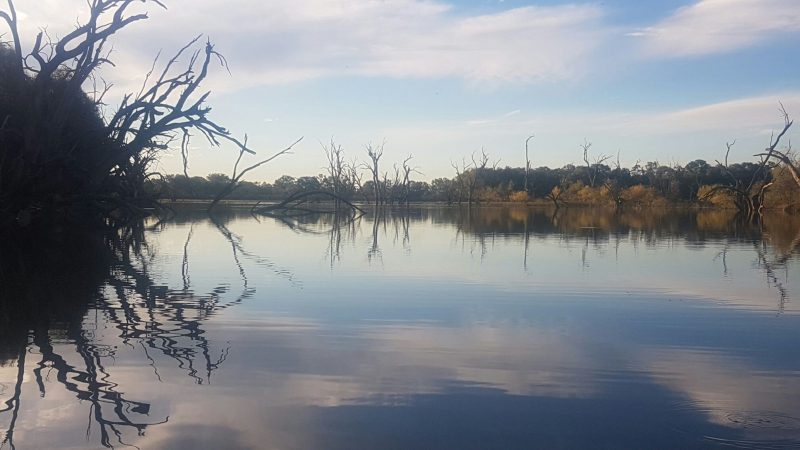
Standing on the banks of the river at night beside the boat ramp, looking at the reflection of the stars in the dark water I saw a small, neglected brass plaque. It told the tragic story of a Scottish family who made the long and arduous trip to Australia then chose to settle in Menindee. It’s hard to think of a place on Earth less like their homeland, or more distant. One sad night they sent their young son to the river to get water. When he didn’t return they sent their daughter to find him. The next day the town turned out for the inevitable bad news. The river was dragged and the bodies of the two children were found together. Standing there in the dark I felt a sense of horror, feeling the pain of those parents who had been through so much to create a new life, who had taken the chance on a new land, standing on the bank where I stood holding onto each other in their agony. I went back the next day to read it again. In daylight the horror of that event so long ago was more dreadful. Looking around at the dry flat terrain and stunted scrub you get the feeling things have never been easy in Menindee. That undistinguished, neglected marker on the banks of the Darling said more about the lives of the pioneers of our country than anything I’d ever read before.
Menindee has two whole streets, a couple of pubs and an excellent general store. We had a good time in Menindee.

Day #44 : Menindee Township – 33km Downstream
Below Menindee the river is wide and flat coming up to the weir and lined with fishing and holiday shacks. We didn’t see much current above the weir with the river running at about 220ML daily. Weir #32 is about 13km downstream from Menindee and easy to portage. The drop on the weir was only about 1.5 metres so we were able to scramble over the rocks, half pushing, half dragging the boats to the water below.
Below the weir the river was the narrowest it had been its length. The banks were lower and the whole feel of the river was different. Around the first bend we saw several people fishing on the banks who told us this location was a yellowbelly hot spot. D. stopped to chat with a friendly local, Damian, who showed him three big ‘belly he’d caught; enough for his family to eat that night. He handed over the rest of his bait, big ugly cooked verdai prawns. The prawns were so big we wondered how a yellow belly would get one into its mouth. Turned out they were a gun bait because even four days later when they were well on the way to decomposition, they were swallowed almost immediately they hit the water, but not by ‘belly. We had our best night’s cod fishing ever, on any river, using those prawns. Thanks Damian!
Wildlife was sparse. We had become used to seeing hundreds of ‘roos and goats each day, but here for whatever reason their numbers were limited. Campsites, too, were a little hard to find through this section, but once we crossed the weir signs of humanity disappeared with every bend and we were able to find a sandy beach where we could land the boats without wallowing.
Day #45 : 33km – 65km Downstream of Menindee
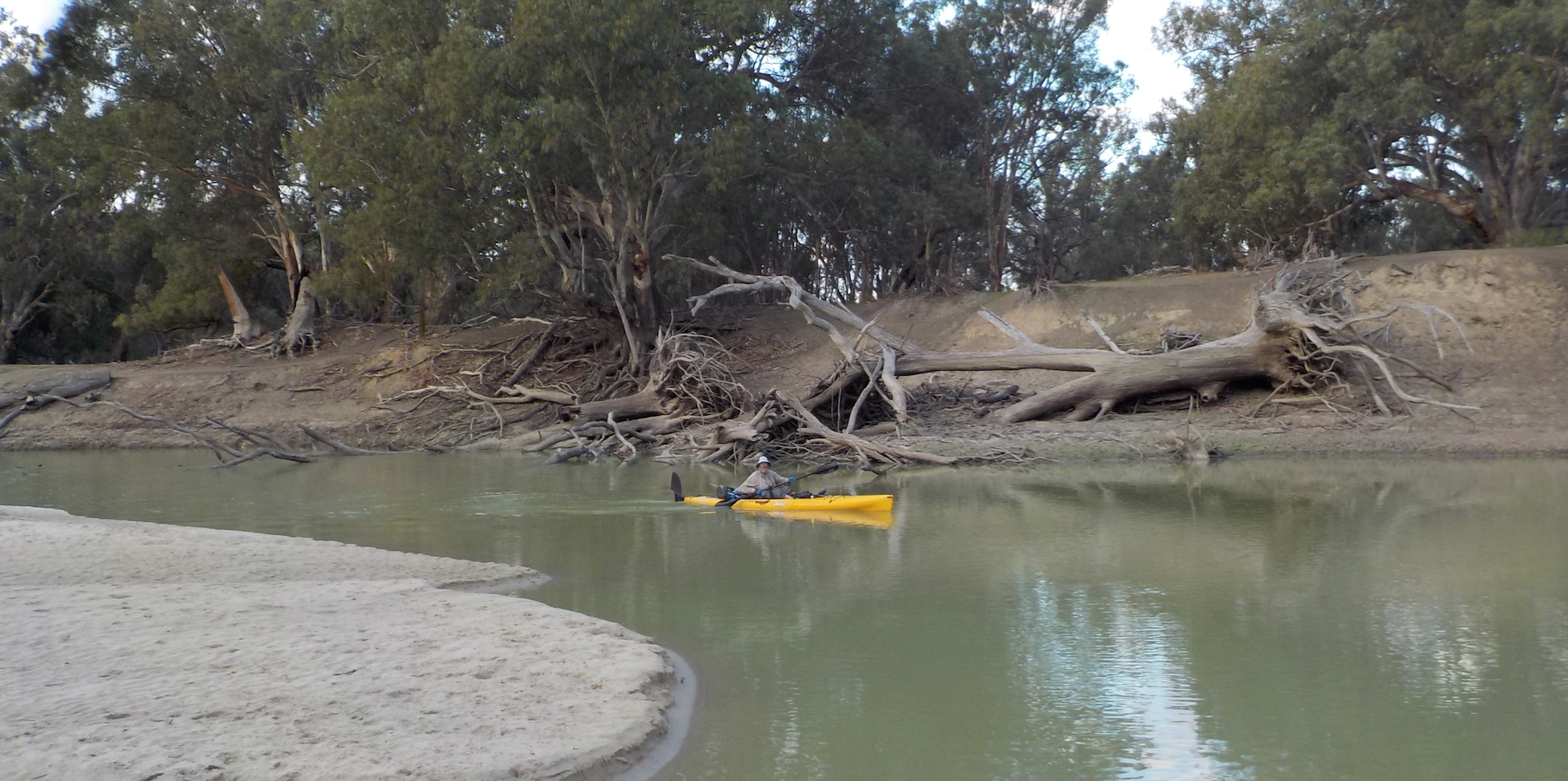
Through this section the river meandered and ran well, though there were a lot of snags. Coming up to them it seemed we would have to portage or drag around several but every time we managed to pick our way through the fallen timber without having to get out of the boats.
The usual large numbers of goat and ‘roos were spotted. Emus too were common and again we saw a group swimming the river, their necks exposed so they looked from a distance like sea serpents. Emus aren’t just quick on their feet. They are good swimmers, encouraged no doubt by our presence they crossed the river in no time and exploded out of the water, climbing the banks at full speed while lowering their necks to counterbalance themselves against the steep banks as they accelerated into the scrub lining the river.
We were used to seeing the various fishing birds the whole way; pelicans, cormorants, darter, but through this section there were few to be seen. Most probably the fishing was a lot better upstream.
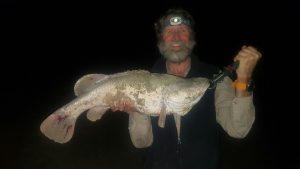
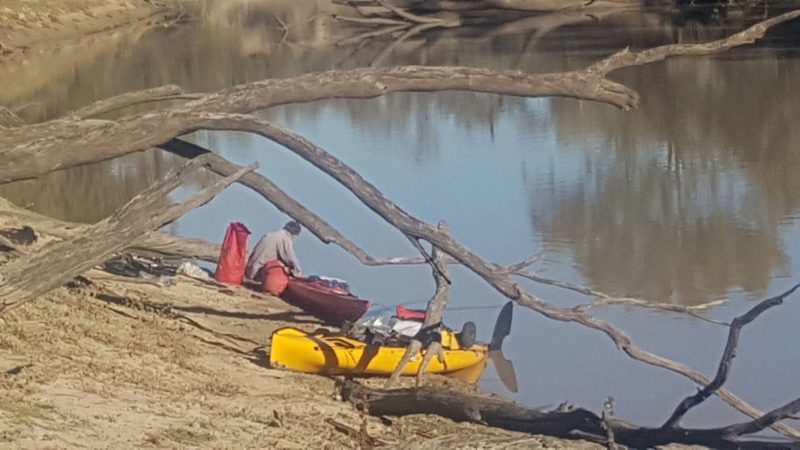
We camped on a small white sand beach at the head of a long straight reach of the river. It was a dark night, no moon to be seen, and skeptically we baited our lines with the prawns D. has cadged earlier in the day. We had two rods out on stands and a handline which W. held in place with a stick stuck in the ground beside the fire. It only took a couple of minutes before something hit the handline hard and we had to scramble to grab it before it was pulled into the river. A legal cod, about 70cm in length. Pale, almost white in places as a result we assumed of the coffee coloured water it lived in. The fish fought hard and unlike most cod, it did not surrender.
As the fish was released and the handline rebaited the bells on D.’s rod rang out in the still night air. Another big hit with the rod doubled over as the fish on the line tore madly up and down the river. Like most cod it gave in quickly after two runs and it swam in submission to the bank, lolling on its side in the mud at our feet. W. drew the short straw and braved the shallows, copping a face full of mud from the thrashing tail of the icthyan for his trouble. A good fish. 84cm in length and like the one caught only minutes earlier it was pale and flabby. Both fish had numerous red ulcers on their tails, suggesting life was tough in the Darling.
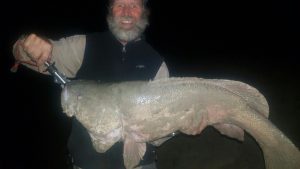
Two good fish in ten minutes, but the action hadn’t finished. The handline went off again. Again it was tackled a couple of metres from the water and a fish of almost the same size, 68cm, was dragged to the shallows. Its manners were no better than the previous two fish, ungratefully showering us with mud and freezing water, but there aren’t many cod fishermen who would not be happy with the whole experience. As we rebaited and cast the line out again the bells on D.’s rod sounded loudly. In mock frustration at being once again called to attend to a fighting fish D. took up the line and this time it was a big fish. This fish wouldn’t give in. It behaved like it was the king of this reach of the river and refused to accept defeat. W. ended up covered from head to foot in mud and frigid water. But it was all worth it, the fish was 93cm, the best we caught the length of the Darling.
Day #46 : 65km – 96km Downstream of Menindee (Bindara Station)
The river was shallow in places through this section, but we didn’t need to get out of the boats, just careful to stay with the current and avoid shoals. But being shallow we had more assistance from the current and it was a pleasant day with the usual quota of wildlife on the banks. There were plenty of snags and fallen trees but we were able to get past every snag without having to portage.
If anyone is planning a trip and specifically interested in fishing out of the way places, this section looked particularly promising. The shallow reaches were mixed with deep holes, all lined with snags and cover which from experience looked like ideal cod habitat. Combined with the action we’d seen the night before we plan to come back one day and spend a couple of weeks through this section.
Day #47 : Bindara Station
On the way upstream we’d left a food drop at Bindara Station. We’d been met by Barb at the gate, that is her and a huge mastiff cross hound which looked like it could tear off a limb, and Barb didn’t look any more pleased to see us than the dog. After a short chat things became clearer. Barb’s beloved husband Bill had died a few years before and in the tradition of tough Aussie birds who can take a 5 iron to a brown snake with one hand while nursing a baby with the other, Barb was running the whole station on her own. It gave us a new perspective on the way she met unheralded guests knocking on her front door. How she does she do it?
The welcome was a lot warmer this time when we climbed the banks and Barb made us right at home.
Bindara is a very pleasant place to stay. The shearers’ quarters were luxury compared to the spartan times we spent free camping on the banks and Barb fed us well. What a pleasure to enjoy a home cooked meal after living on noodles and muesli for weeks. In a tree hollow a couple of hundred metres from the homestead a pair of major mitchell cockatoos were nesting. Looking like a dandified version of a typical cockatoo; the sulphur colour of the crest replaced with several subtly blended shades of pink, their serene and gentle demeanour was a further contrast with the loud, scrappy antics of their more common cousins.
We sat around the fire chatting into the night with Barb and a few other travellers who’d arrived earlier by 4WD. Skirting the light thrown by the fire we spotted a pair of young foxes. Barb took a motherly position on them and we saw they were obviously used to being close to people. The next morning when W. went to get something from his kayak the native villainy of ol’ reynard was revealed. The miscreants had chewed through a cover on one of the kayak hatches to get to a bag of food inside the boat. The bag was gone. Only circumstantial evidence of the crime remained.
Day #48 : 96km (Bindara Station) – 130km Downstream of Menindee
We left Bindara together, Barb waving to us from the top of the bank. The river meandered wildly through this section and it reminded us more and more of a scaled-down version of the Darling we’d paddled above Bourke. After a couple of hours paddling we met a young fellow, Chris, on the banks who only moments before had caught a 94cm cod. Chris was pleased to see us and have somebody to tell about the fish he’d just landed. He was fishing with freshwater mussel meat, something we’d considered but never tried.
The current continued to give us a little assistance through this section, though camp sites were harder to find than usual. We found that the steeper the angle of the bend the better the campsites. Where a bend was like a hairpin it seemed that the sand accumulated more readily and of course it was more likely that the water in front of the campsite was deeper and better for fishing.
The most notable sight of the day was passing the Darling anabranch. It was dry but the junction held an excellent looking campsite which from the looks of things could be accessed by road. Definitely a campsite worth considering if you are in a 4WD.
Day #49 : 130km – 168km Downstream of Menindee
This section includes a number of long straight reaches which were beautiful to paddle with a relatively strong pull from the current most of the way. Plenty of snags but all easily avoided. Over the years we have often debated what river pattern we prefer. D. likes the curves and the bends while W. prefers the straights. The Darling has something for everyone!
It was cold that night. The day hatch of W.’s kayak was frozen shut and the ice was like stone. It must have been well below zero that night.
Day #50 : 168km – 200km Downstream of Menindee
The long straight stretches of the previous day were gone and the river reverted to its 2/1 – 3/1 meander. Very few waterfowl other than a couple of lone pelicans though we saw many wedgetail eagles and several sea eagles. The river banks were steep and high, classic Darling River form as we had seen most of the way upstream. Most bends of the river held good campsites and again we had assistance from the current most of the way.

Day #51 : 200km – 236km Downstream of Menindee
With the assistance of a strong NE wind and as much current as we has seen to that point on the river we made good time. Passing the exposed ribs of an ancient shipwreck on one corner we were reminded how 100 years before the river was a highway which serviced a population many times what it is today.
The river was steep banked most of the way but on almost every bend there was a small sandy beach ideal for camping. That night we found an excellent spot opposite a high banked bend. As night fell it was like being camped by a waterhole on safari in Africa. A procession of ‘roos, emus pigs and goats came down to drink, even though we were only 20 metres from them they didn’t seem to care we were watching. Mainly grey kangaroos, there were also a number of euros or wallaroos which are a light russet with a painted face, almost a cross between a grey and a red.
Day #52 : 236km – 274km Downstream of Menindee
We’d been looking forward to the short-cut shown on the maps. Our plan was to paddle 35 – 40km each day so if a short cut came along which saved 4 or 5 kms it meant more time lounging in camp. The short-cut was dry. It would have required dragging the boats over more than 400m of mud to get to the water.
There was a little current during the day but we felt the water starting to pool from the Pooncarie weir downstream. The banks were muddy and we didn’t see many good campsites.
Goats came into the camp that night and the next morning and we had to chase them off. Caught nothing but carp on the lines at night using cheese as bait.

Day #53 : 274km Downstream of Menindee to Pooncarie (294km)
Hardly any current at all but we spotted many attractive campsites on the last 20km into Pooncarie. Lots of pigs. We spoke with a young fellow camping on the banks who told us he’d shot two big boars the night before. We paddled hard to get to Pooncarie before lunch, both of us keen for a steak and a coca-cola.
The river was a light grey/brown/green khaki-colour which the locals told us was the best colour for the river to be. Several people told us that when the water was more opaque it stopped the blue/green algae from blooming.
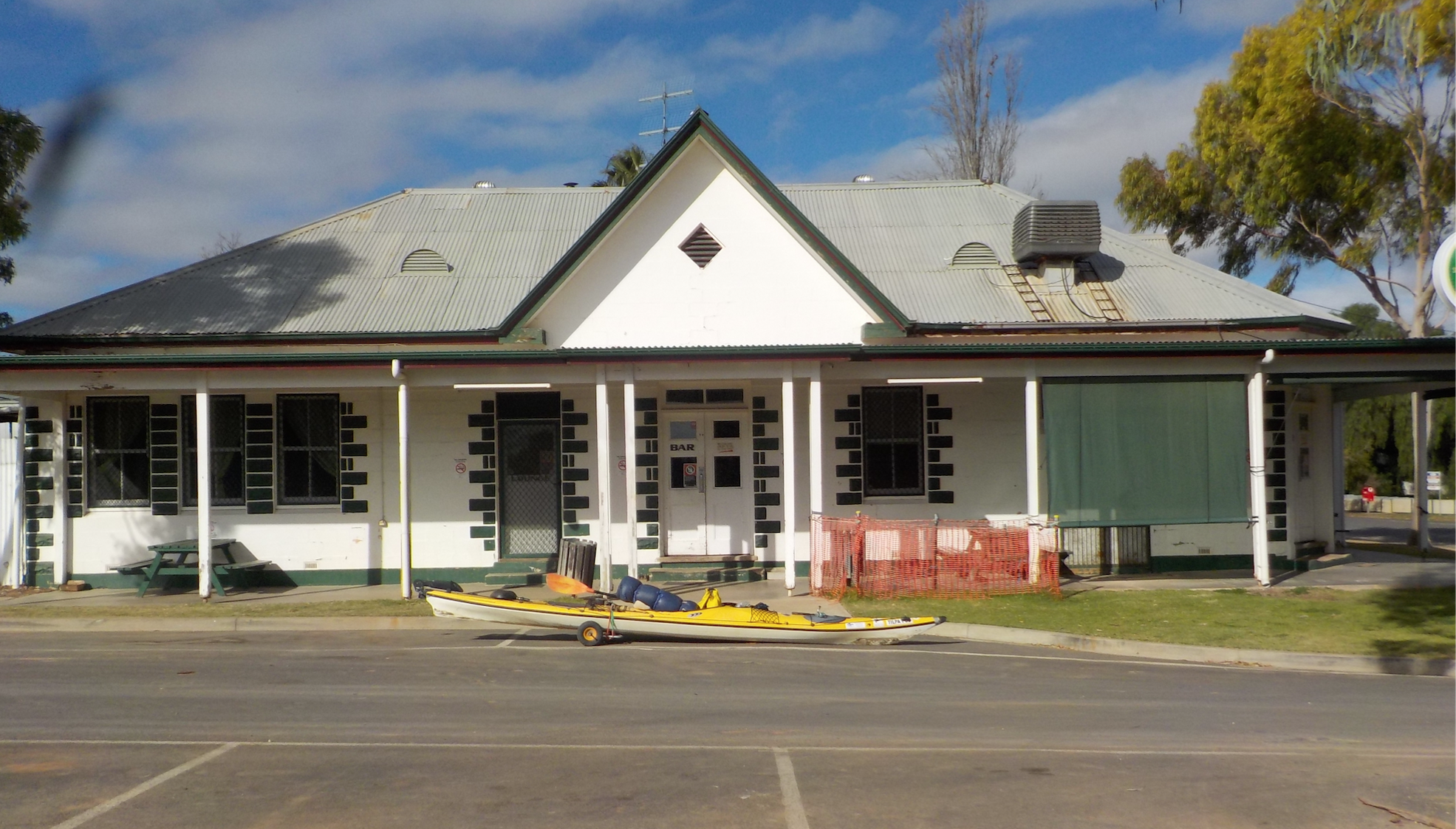
There’s a small boat ramp a couple of blocks from the main street or Pooncarie. We had no problem getting the boats out and putting them on trolleys then walking a couple of hundred metres or so to the pub. We parked the boats on he street outside and propping ourselves up at the bar were told that there was no steak on Wednesdays, only Thursday to Sunday. Devastating.