
Day #22: Killara Station, 153kms Downstream of Louth – 15km of Tilpa
We had a great time at Kallara station. It was about 10km by road to the Tilpa pub. The river rose about 4cm overnight from rain which had fallen on the NSW Qld border a few weeks before.
About 5km upstream of the pub is a small weir we were able to walk over in a few minutes without needing to unload the boats. The banks were lined with grey nomads, several of whom were excited enough by what they saw to video our portage. Not a lot of wildlife or animal activity through this section. D. sighted a fox with full winter coat asleep on the bank.
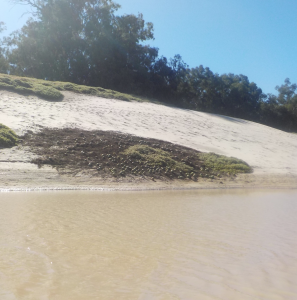
The river was largely long straight stretches. Below Tilpa there were houses on a few of the bends, most of them opposite or next to the best camping sites. Eventually we settled on a high banked, sandy campsite which required us to carry our gear up a steep sand bank.
Day #23: 15km – 52km Downstream of Tilpa
The river fell about 1cm overnight. The weather changed overnight with a cold southwest headwind most of the day. The river was shallower than usual through this section and on almost every bend the current swirled with large back eddies which made paddling more difficult. It was a hard day’s paddling to cover only 35km.
Many beautiful beaches through this section. At the “ten mile bend” shown on the maps is a cloverleaf shape series of bends on the river with beautiful beaches on every bend.

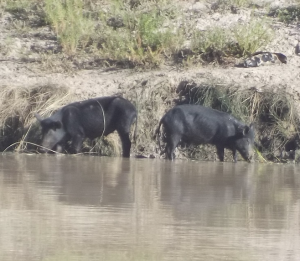
There were a lot of pigs through this section and more cattle than we’d seen anywhere else upstream. D. spotted two steers swimming the river and at another point the sickening spectacle of a family of pigs feasting on a bloated carcass. None of the pigs even looked up as we went past.
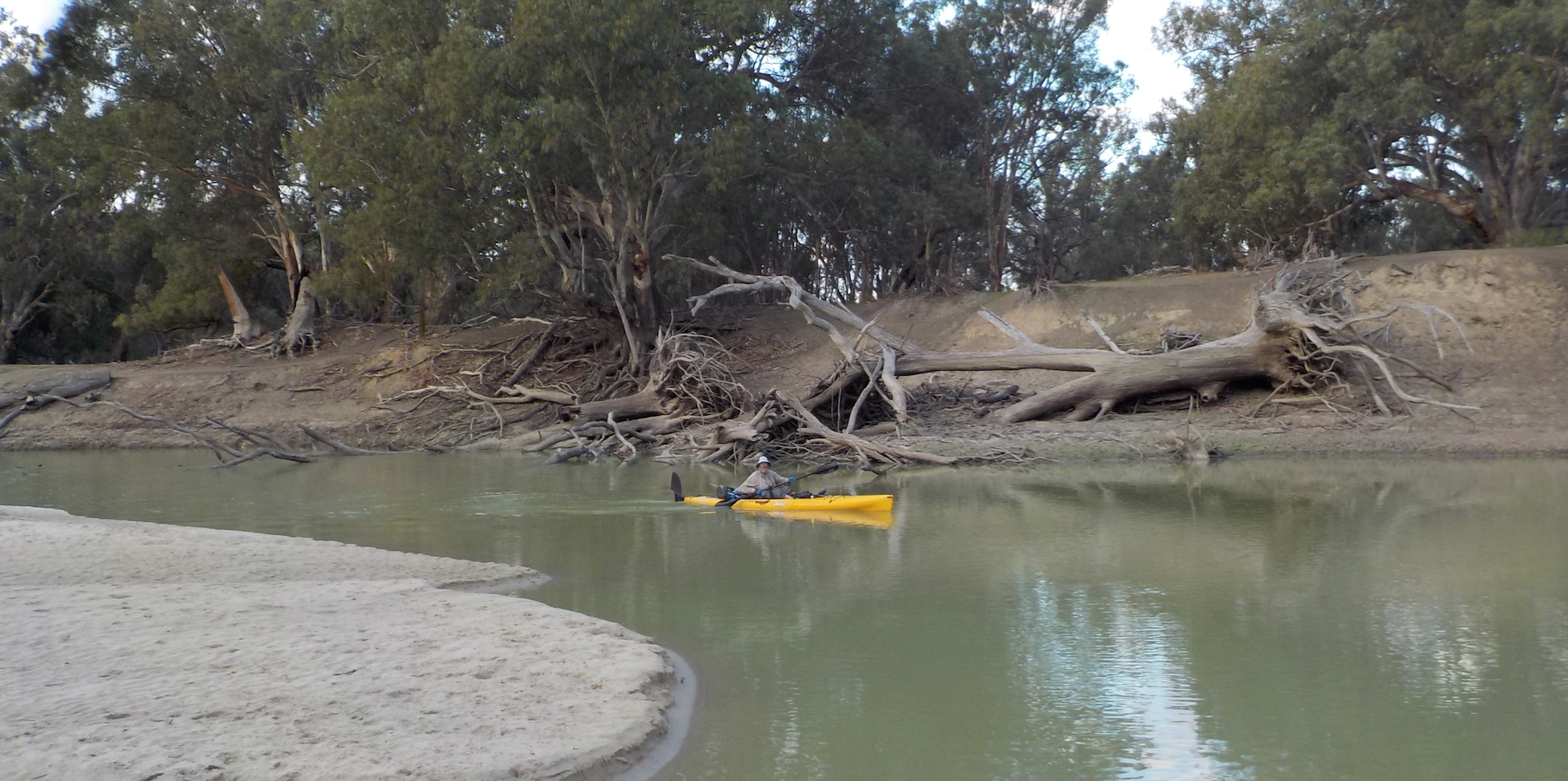
As cattle were being run through this section we noticed how much damage they did to the banks compared with the sheep country. We settled on another high-banked sand bar as the best camping option.
Day #23: 52km – 88km Downstream of Tilpa
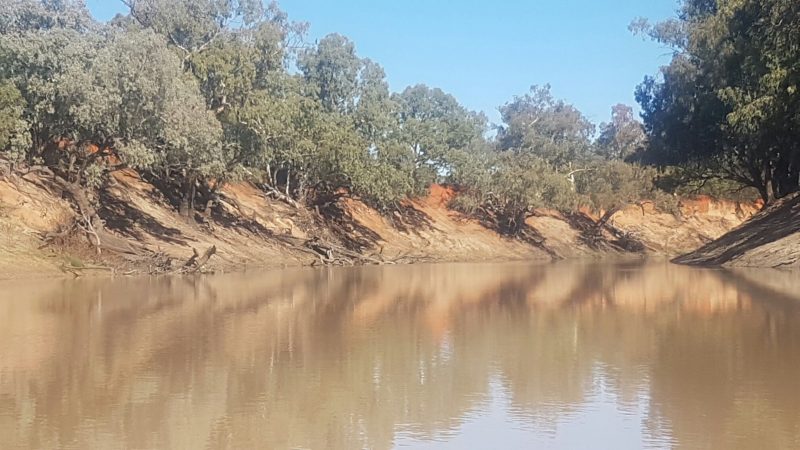
The river was very interesting through this section and there was also a lot of wildlife. The river narrows and runs faster with multiple shallow reaches where the banks come down almost to the level of the river in some places.
Plenty of ‘roos through this section, including wallaroos or euros which are a russet coloured medium sized kangaroo with markings on their face. We did see a few big red desert ‘roos through the course of the whole trip, but they were rare.
Spotted a huge flock of red tailed black cockatoos. As we paddled along several broke away from the flock to swoop low over us and have a better look. As always they then returned to the group and the squawking and cackling went on as they exchanged views on their impressions of what they’d seen.
The south-west wind kept increasing in strength most of the day. It seemed that along every reach we were paddling straight into it. By shortening the stroke a little and increasing rating it was a little easier to paddle into the wind.
Between the 70-75km mark the river split in two and ran around a large island in the middle of the river. One side was almost blocked, the closest thing to a blockage of the river we’d seen since we started.
We camped on a low beach that night and after lighting the fire a willy wag tail flew in and sat on a piece of wood by the fire. As bugs and insects were disturbed by the fire the bird feasted, but it also seemed to be enjoying the warmth.
Day #24: 88km – 125km Downstream of Tilpa
The wind dropped overnight and when we woke the sun was out and the weather was showing signs of improving. There was a lot of birdlife through this section, many wedgetails sighted in the trees on the banks. We started to see major flocks of cormorants and pelicans. On one bend we saw about a dozen pelicans in an exact line fishing together, putting their heads underwater in unison and filtering the catch in their bills. They were catching plenty.
No pigs sighted for the whole day and a lack of good quality campsites because the river was largely long, straight reaches with very few bends which would allow the beaches to form. A lot of goats, roos and birds sighted and most showed a lot of interest in us. If the wind was right and we were downwind we could get very close before they realised we were human and posed a potential threat.
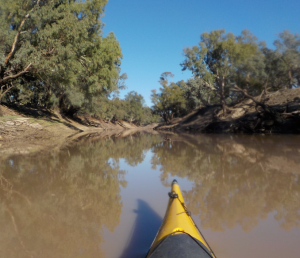
Camping that night we saw a low flying flock of pelicans which were only a few feet above the level of the water. There were about 30 of them flying in formation and it looked like they were looking for a spot to roost for the night.
A red kangaroo doe appeared on the edge of our camp after dark. It seemed disorientated and stood staring at us for a while before slowly hopping off into the dark.
Temperature fell to 3 degrees overnight.
Day #25: 125km – 162km Downstream of Tilpa
River ran slowly through this section. Conditions changed and we saw rocky ledges and small rapids most of the day. Plenty of pigs and ‘roos through thus section. The pigs let us get within 10 metres almost every time. The south-west wind picked up again and most of the day we were paddling into the teeth of it. Euros (wallaroos) were most common through thus section. They are a beautiful looking animal which seems to be more likely to travel alone than the eastern greys which were still the most common. Plenty of wedgetail eagles.
The river was steep banked and there were not a lot of good campsites. we were tired at the end of the day’s paddling after paddling in relatively tough conditions for 5 days straight.
Day #26: 162km – 193km Downstream of Tilpa
Interesting river conditions through this section with rock formations on the banks and small rapids very common. Most of the sharp bends in the river held major rock formations. The strong southerly wind continued to blow and grew in strength as the day progressed.
At the 183km mark there was a large island in the middle of the river. A rocky bar blocked the whole river but there was access through a small shady glade off the river on the right.
We camped on the only sandy stretch we’d seen all day and while setting up camp a wedgetail eagle landed in a tree opposite and watched us carefully.
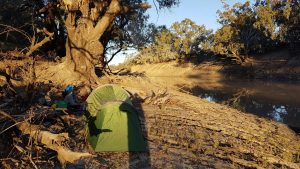
The campsite we chose at the 193km mark was an interesting one. About 400m away were a couple of old buildings. We went for a wander and saw that it was a deserted shearers’ quarters. There were half a dozen ramshackle buildings with a fly-screened, outdoor kitchen in the middle. It looked like the last residents had been a team of artists as there were half finished canvasses stacked in one of the rooms. Somebody had written on the wall in 2002, listing the temperatures of a heatwave. 47 degrees, 45 degrees, 44 degrees. The next comment on the wall was “5” of rain overnight”.
Day #27: 163km – 192km Downstream of Tilpa
We were woken by kookaburras that morning. One of the few times we’d heard them on the river.
This was a section we’d been looking forward to paddling as we would pass the mouth of the Paroo River. Only twice in recorded history had the Paroo flowed freely into the Darling. Our greatest ambition is to one day paddle its length, but most likely there will never be enough water to make the trip.
The river was interesting through this section, becoming narrower and faster flowing. There were many rock formations and minor rapids, none causing any difficulty. The weather was cold all day and there was a biting wind which seemed to have driven large flocks of sheep to the river where they sat under the banks seeking protection from it. On one bank was a huge flock of merinos. On the opposite dopflers. There seemed to be some sort of disagreement between the two camps. Both side of the river were bleating and vocalising and responding to those on the opposite bank but it didn’t sound like they were getting on.
The Paroo was a bit of a disappointment, the mouth completely dry. The section where the Paroo joined was narrow and overhung. It was a narrow and shady and section of the river, unlike most of the Darling and unusual for a major river junction. More evidence the Paroo rarely flowed.
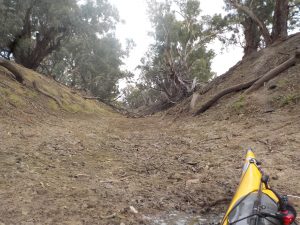
We camped about 1km past the Paroo junction. We caught a couple of yabbies in the pot overnight and used them as bait but only caught carp. Two of the carp were real lunkers, around 10lbs in weight. It rained briefly that night, the first rain we’d seen since Bourke. Sitting on the ground beside the camp was a large “boule”, a scarified piece of a redgum tree which is filled with dried sap and swirling patterned grain. We called it the “palladium” as it looked like a meteorite in a B sci-fi movie when it was alight. It burned beautifully all night and we had to kick the remains into the river the next morning as it looked like it would keep burning the rest of the week.
Day #28: 192km – 219km Downstream of Tilpa
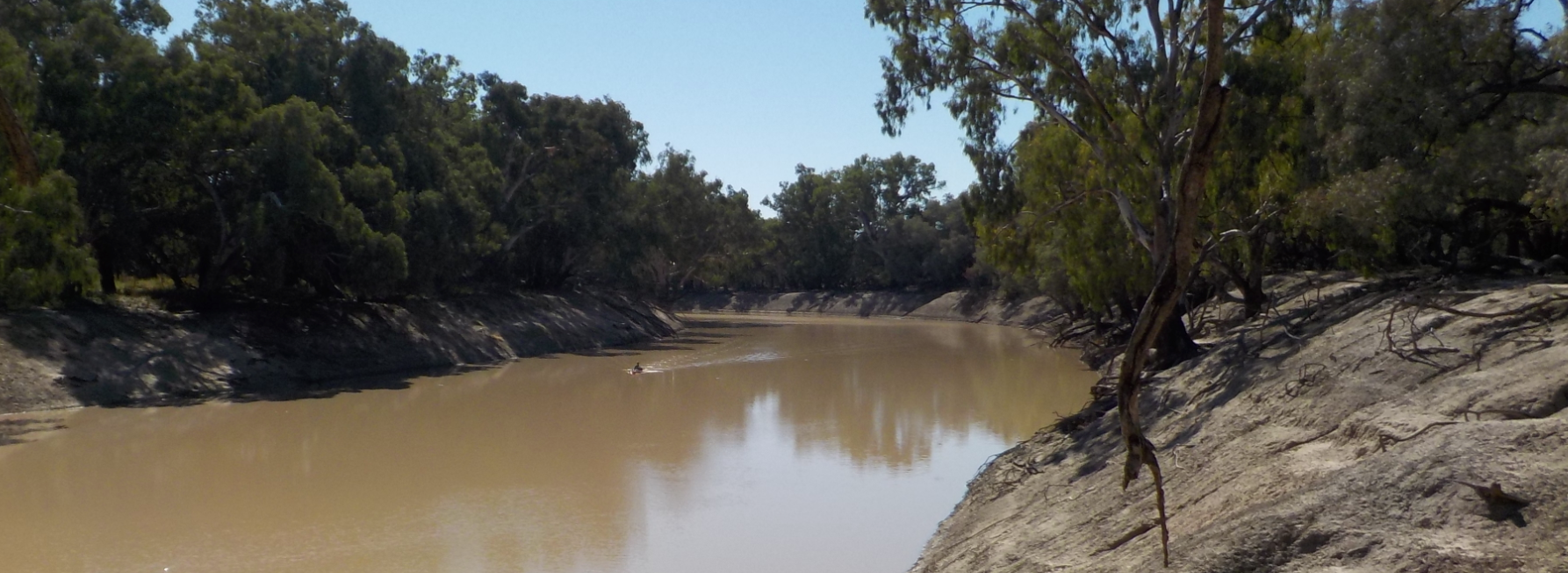
After about 5km the current stopped flowing as the effect of the Wilcannia weir caused the water to begin to pool. Plenty of wildlife through this section and the river was wide, deep and slow moving. Most of the reaches were long and straight with sweeping bends. Good quality campsites were hard to find and most of the access points were muddy.
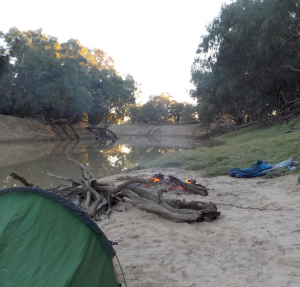
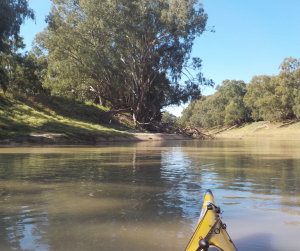
We fished that night but didn’t catch a thing. Many roos and goats came to drink on the opposite bank as the sun set. We were running out of food and water with only a couple of bottles between us. Only 16km to go to our next rest stop at Warrawong Station. A few kilometres upstream of Wilcannia.
Day #29: 219km – 257km Downstream of Tilpa
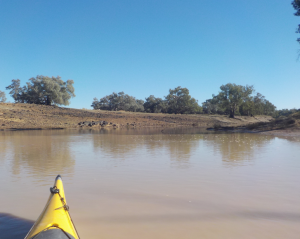
Almost no flow through this section, the river was wide and deep. As the current fell away to almost nothing the water became clearer so you could see maybe 10cm into the water. Huge flocks of cormorants and pelicans fished on most reaches.
Day #30: 257km – Warrawong Station (Wilcannia), 273km Downstream of Tilpa
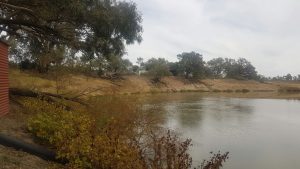
Everyone will advise you to stay at Warrawong Station rather than staying in Wilcannia itself. Wilcannia is not a pleasant place. The police paddy wagon was doing laps of the town looking for indigenous residents to put in the cage. The town was once a beautiful place with some beautiful old stone buildings built long ago.

1 Comment
Add Yours →Hi thanks for posting this report. I have driven this section many times & always wanted to explore by kyak. I now have a Mirage 580 & I’m training to improve my fitness doing 10 to 20 ks every other day in the Richmond River Ballina. I have a few questions when did you do the trip how high a water level do you think is required. Would it be possible to complete solo or will I need to find a friend to help . Are there any sections where a fiberglass kyak may get damaged on rocks rapids .
Mike